Case study
Scout
AI outreach that finds the people, books the calls and writes them up.
- Role
- Technical founder. Designed and built all of it
- Stack
- React, TypeScript, Hono, Cloudflare Workers, D1
- Year
- 2026. Live at okscout.io, in early access
- Origin
- Built for our own I-Corps interviews on FRED
Summary
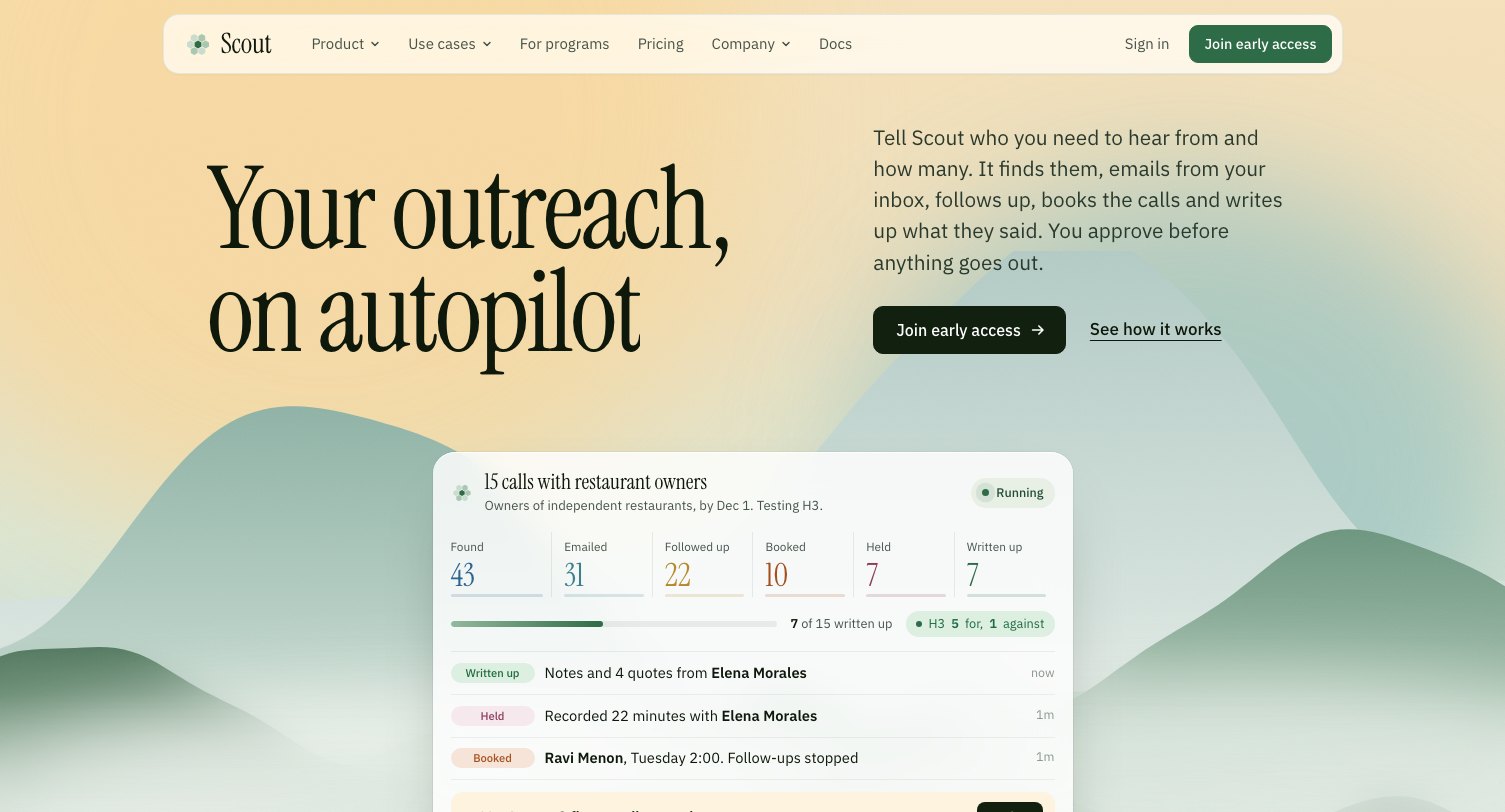
Customer discovery means talking to a lot of strangers, and most of the work is everything around the call. Scout takes a goal like 15 calls with restaurant owners by December, finds people who fit, emails them from your inbox, follows up, books the calls and writes up what was said against your hypotheses. You approve the list and the first email. It does the rest.
94%
of eval cases passed on the cheap model, up from 73%
16/16
grounding cases passed, up from 1 of 12
1.0s
median chat turn on Claude Haiku
0
emails sent before a person approves the batch
My part
What I built
All of it, from the first commit in October: the product, the agent, the website and the infrastructure.
- Missions
- The loop that finds, looks up, drafts, sends, follows up and books until the goal is met or the deadline passes.
- Finding people
- Planned web searches, a screen that scores each person out of 100 with reasons, and a source link on every suggestion.
- Email lookup
- A waterfall from the person's own page to Hunter and Apollo, then mailbox checks before anything is sent.
- Outreach
- Sends from the person's own Gmail or Outlook, with sequences, reply handling and its own booking pages.
- Meetings
- Recording from Meet, Zoom, Fathom, Fireflies or a Chrome extension, transcription, then notes and evidence for each hypothesis.
- MCP server
- Scout's data and tools inside Claude and ChatGPT, read and suggest only, on the same daily budget as the app.
- Design
- The Open air look for the app and the weather-toned website, both tested for contrast in light and dark.
- Evals
- Routing, drafting, screening and grounding suites, judged by a stronger model, run before any prompt or model change ships.
Landing page
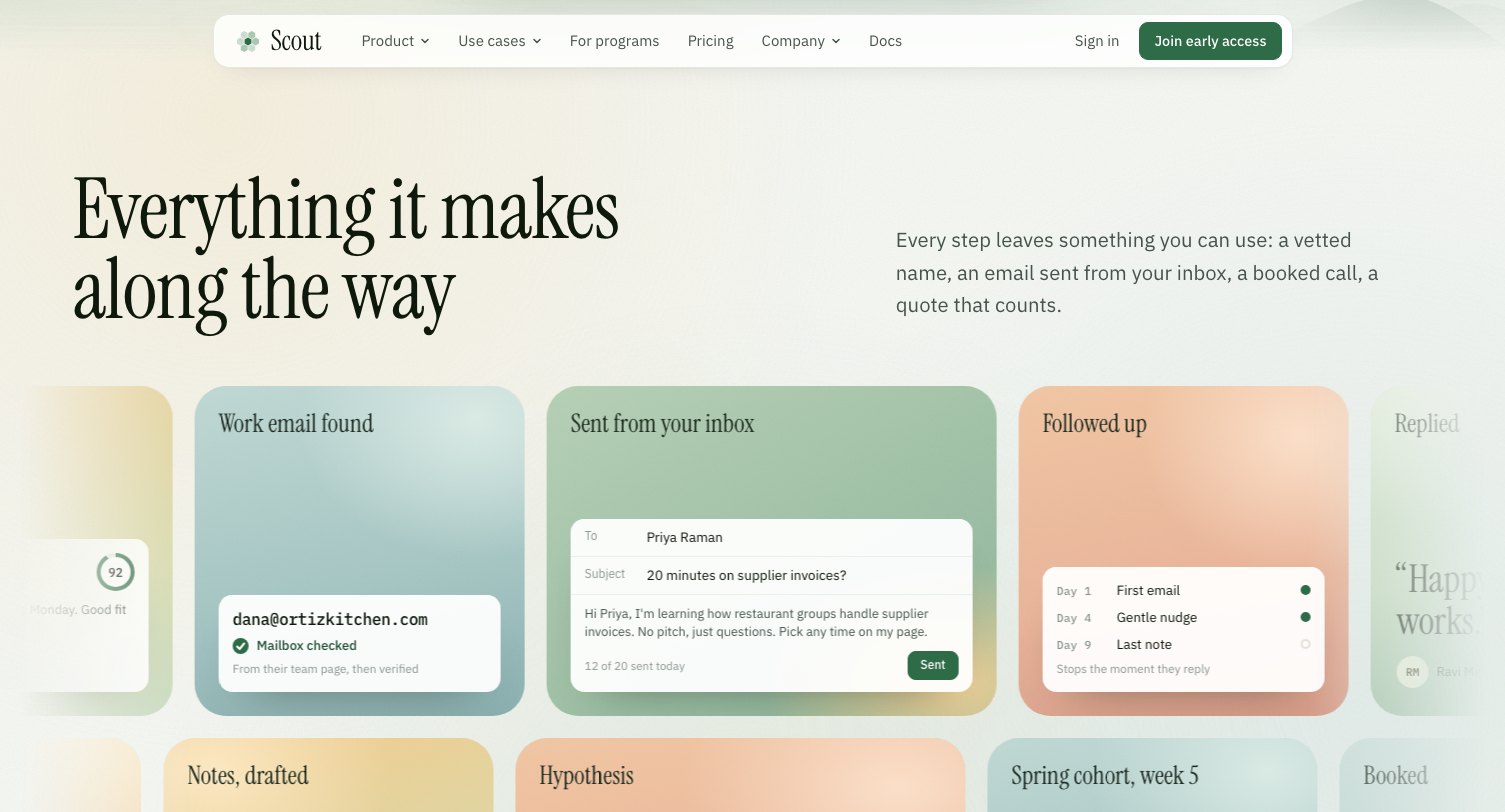
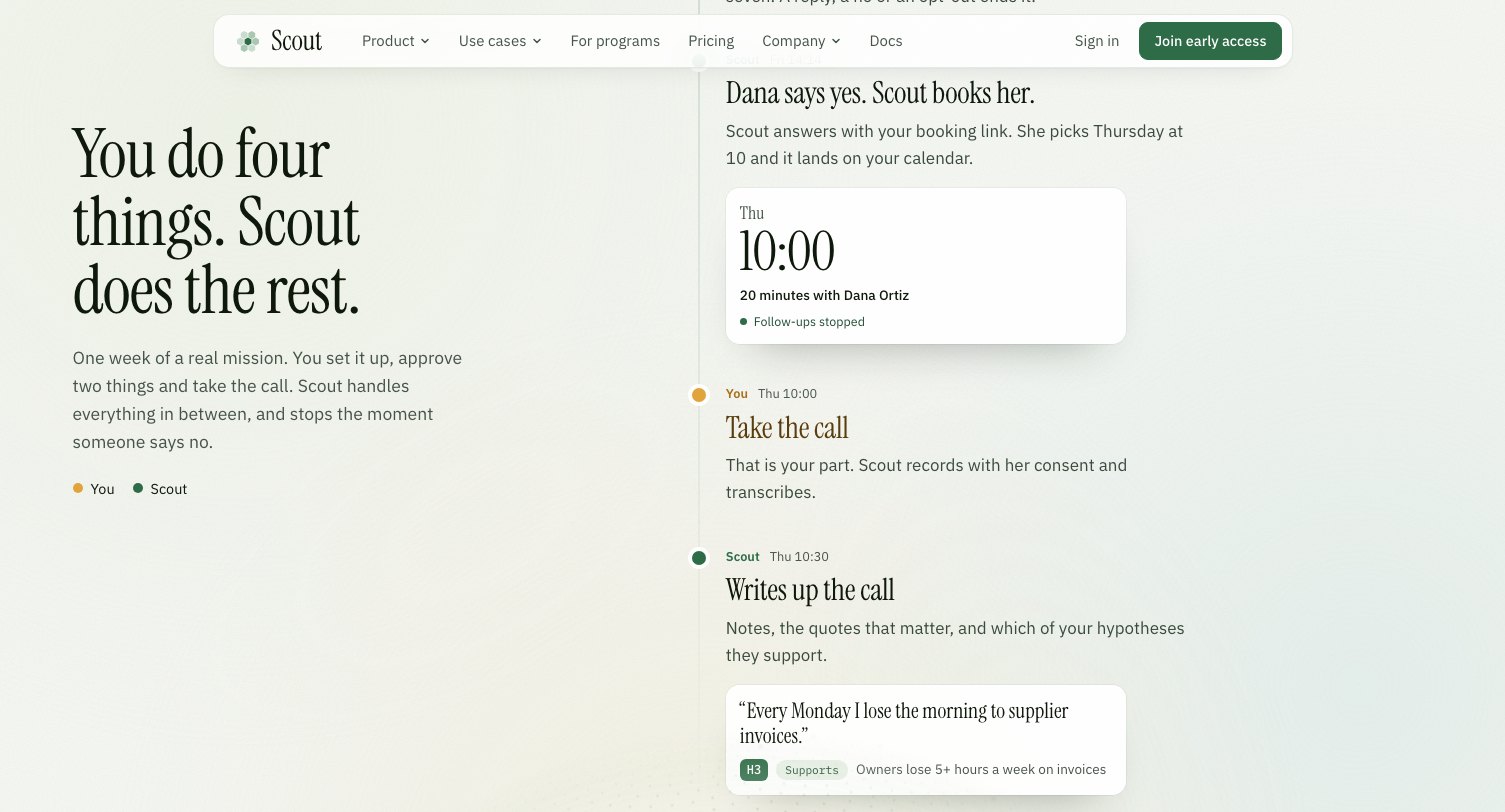
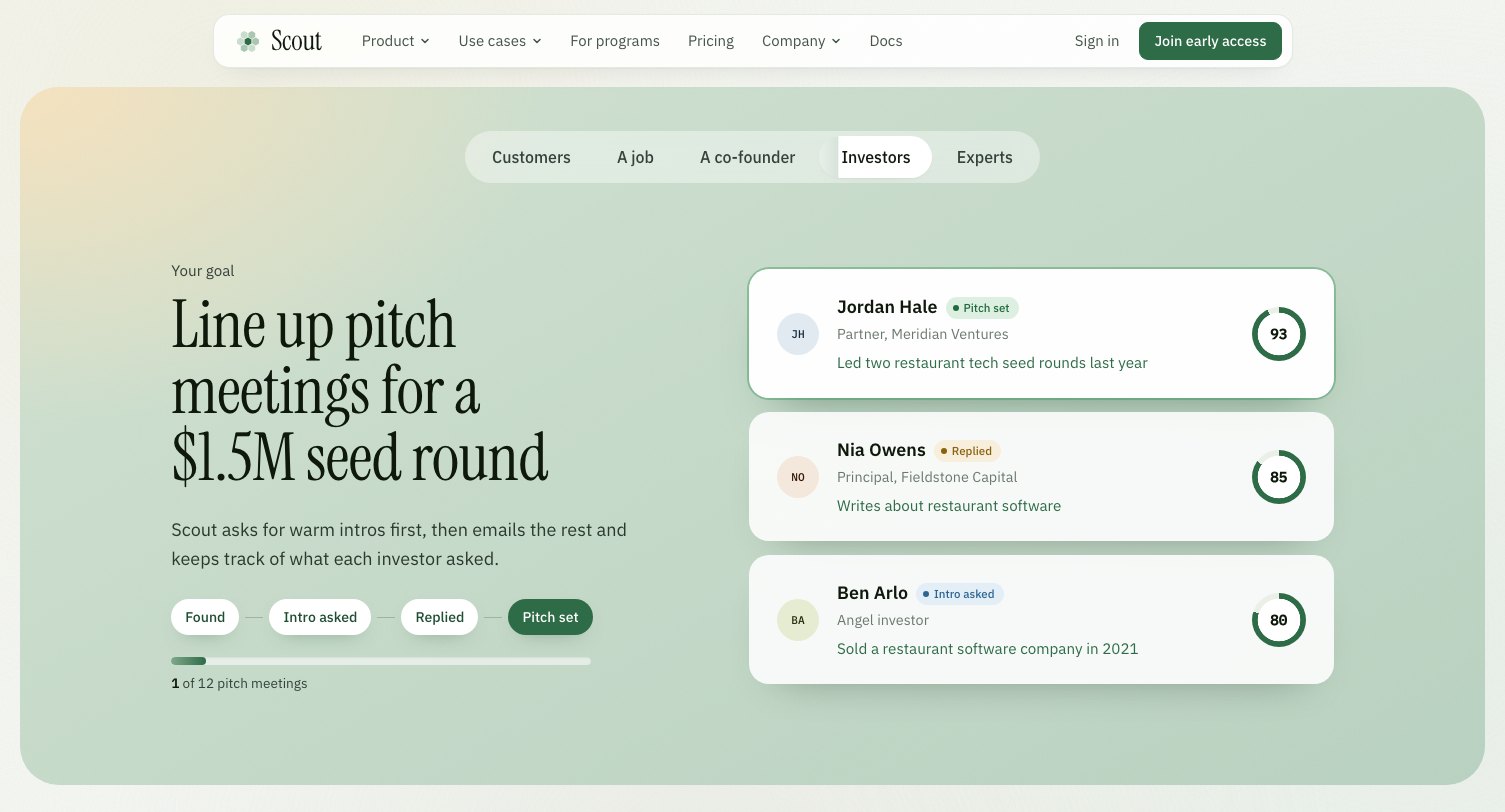
A landing page that walks through one real week
No feature grid. The page follows one mission from the goal to the write-up, so a visitor sees what Scout makes at each step.
Product
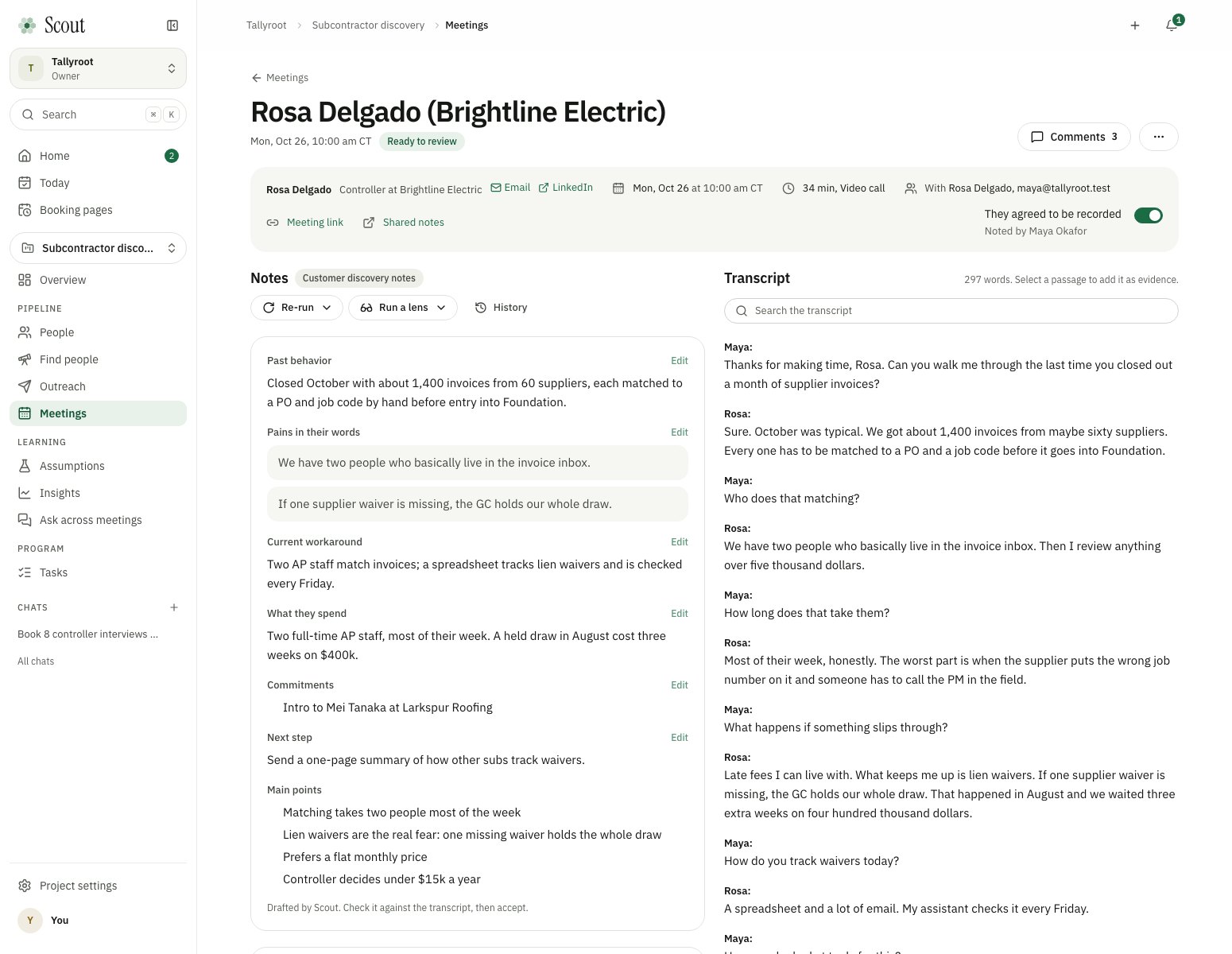
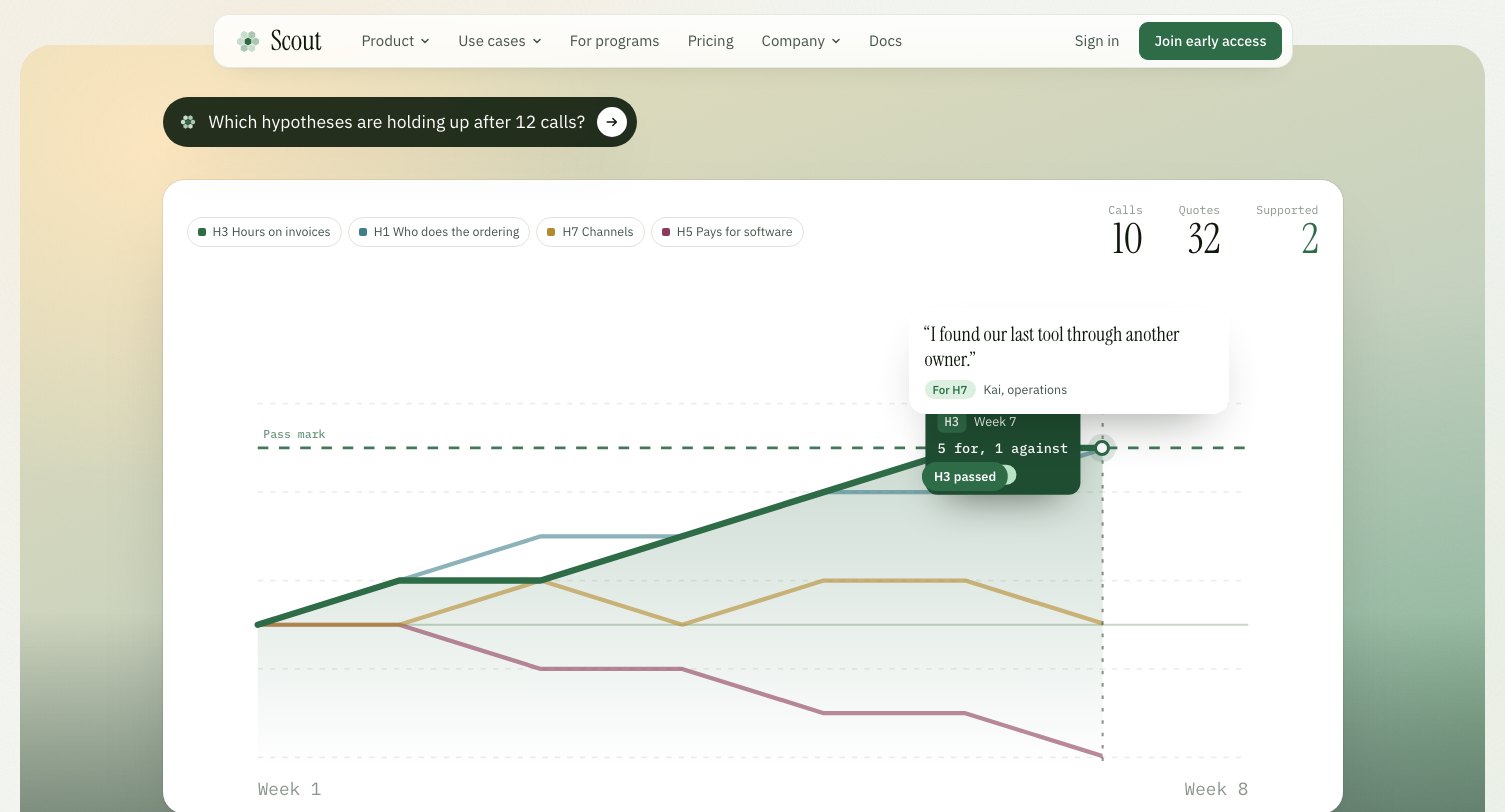
From a call to evidence you can check
After a call, Scout drafts structured notes beside the transcript. Nothing counts until a person accepts it.
Mobile
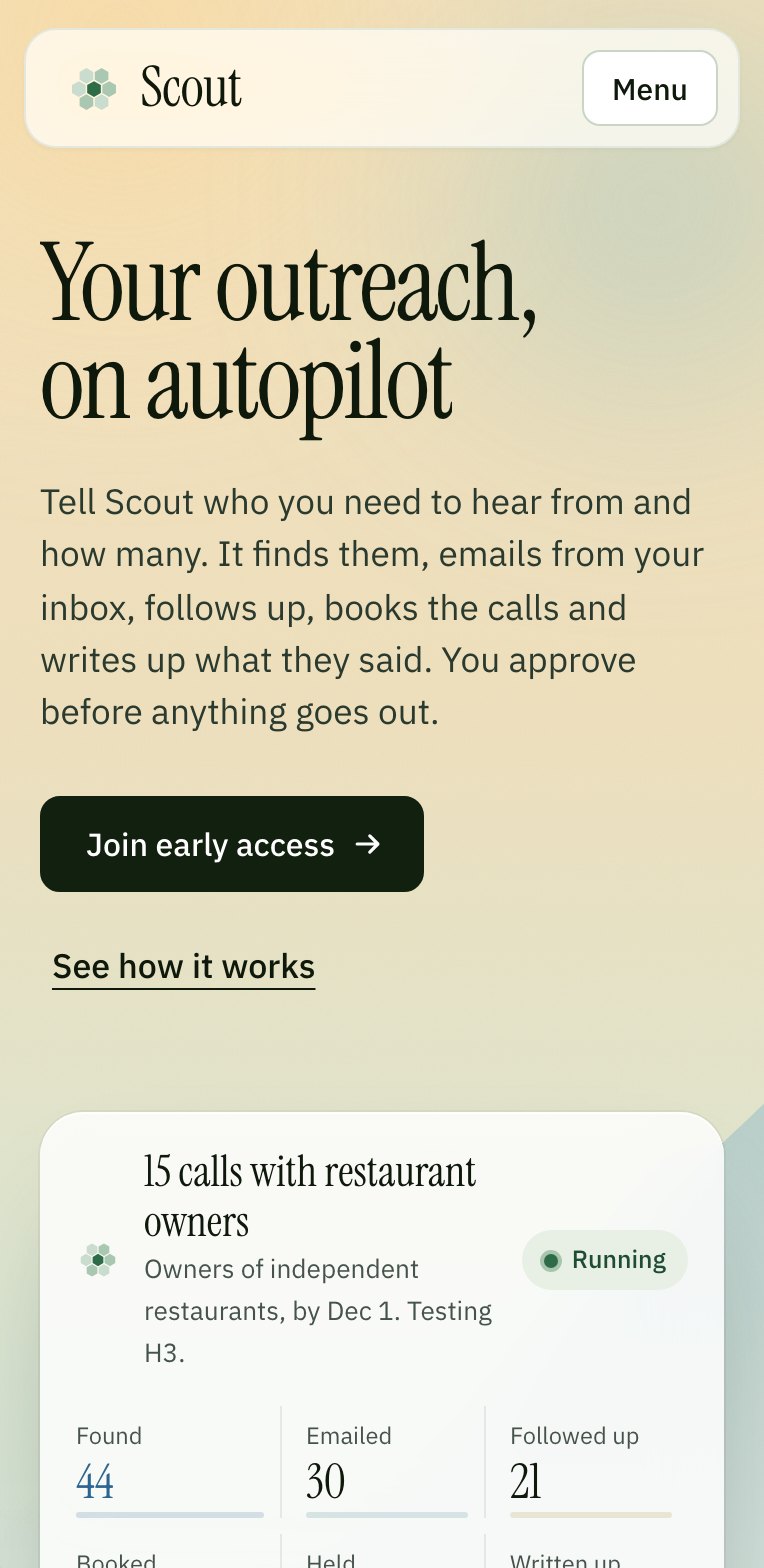
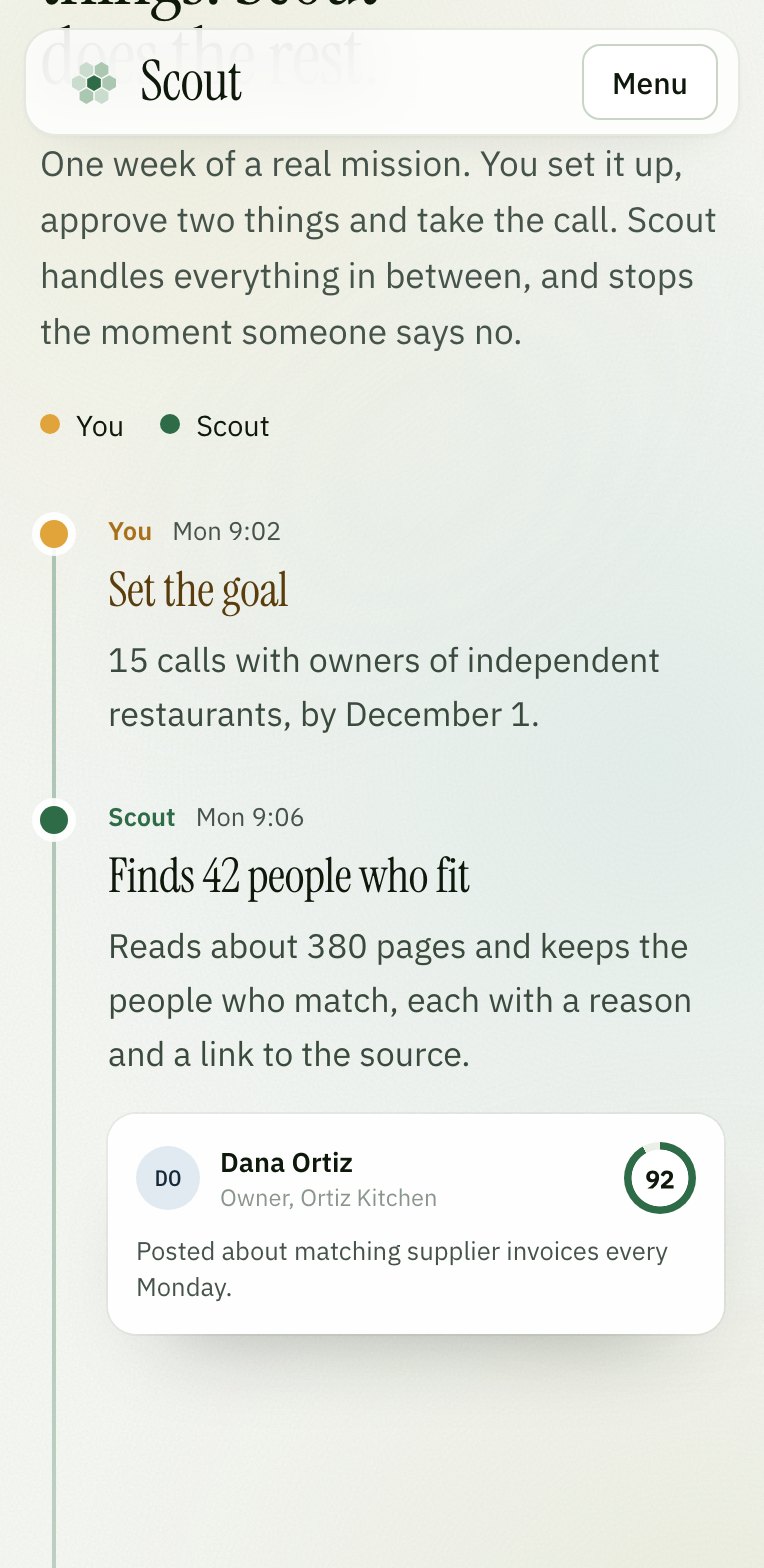
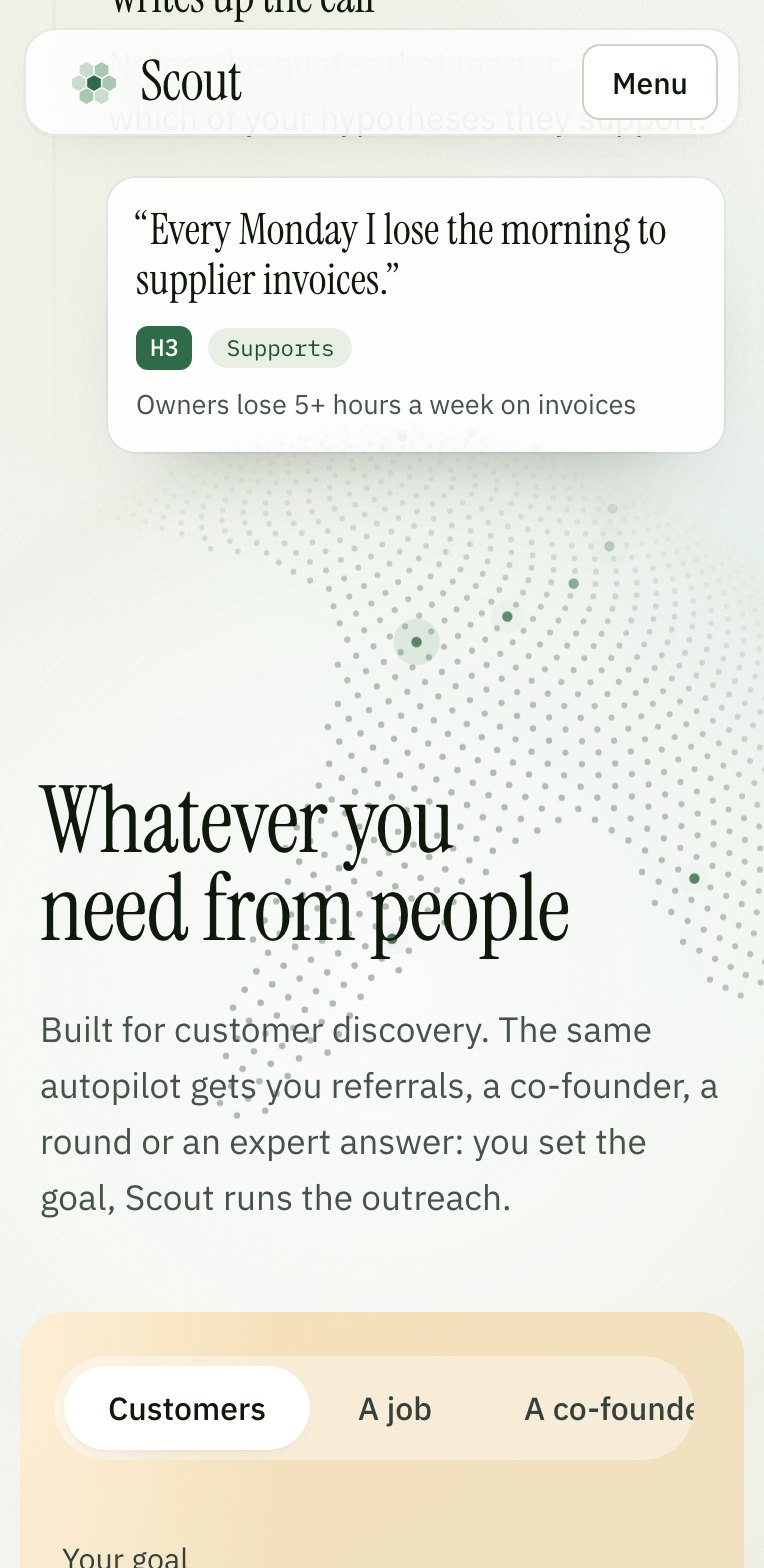
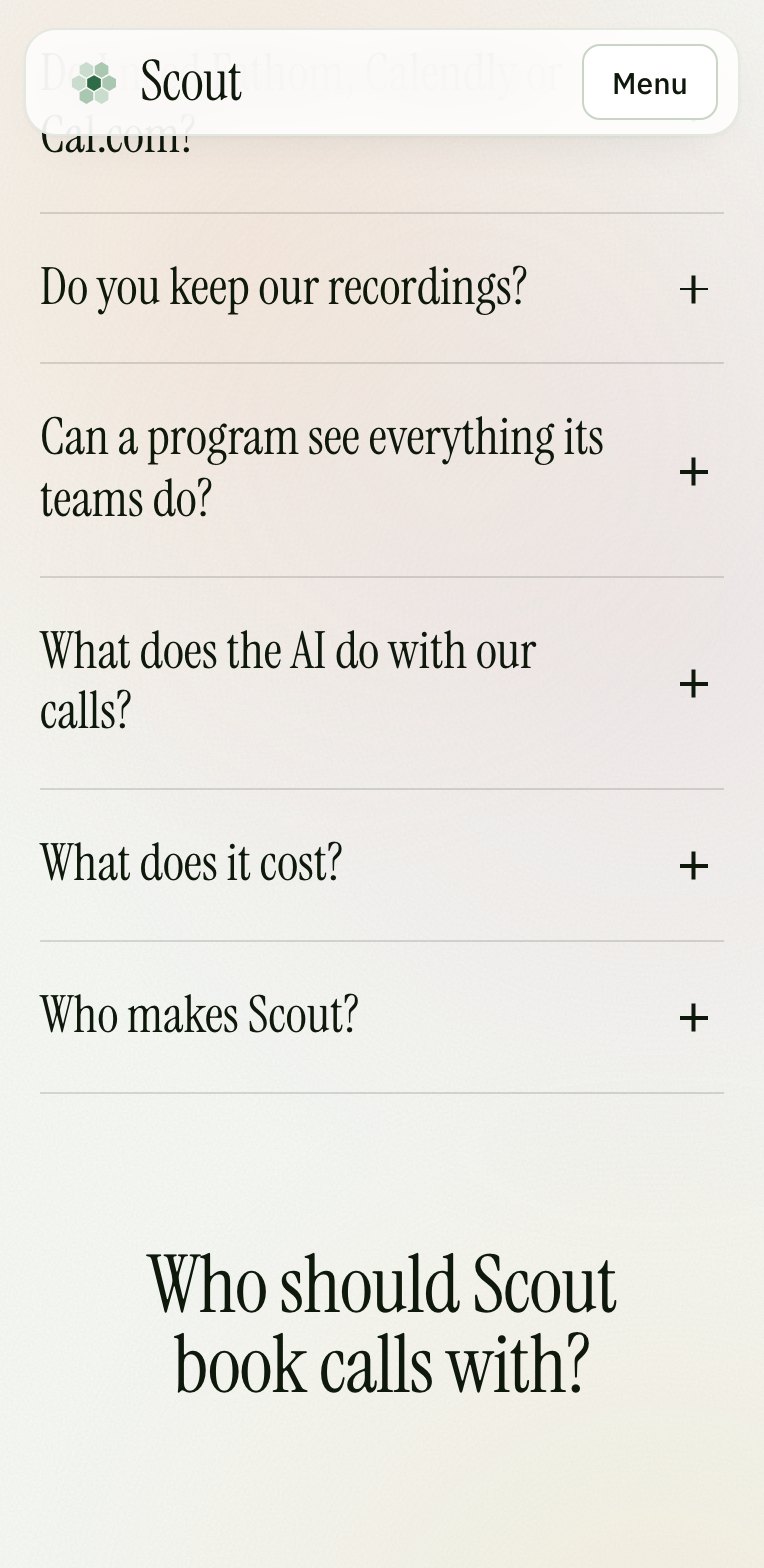
The same week at 382 pixels
The hero puts the promise first and the mission card below. The timeline drops to one column with the rail on the left, and the feature tabs scroll sideways.

Design system
Open air, weather tints and one green
- Ground#EEF0EB
- Panel#FFFFFF
- Ink#151714
- Scout green#1B6B45
- Sun#F3CF93
- Sage#C7DBBF
- Dusk#EAB89E
IBM Plex Sans
15 calls with restaurant owners
Interface, headings in the app
Instrument Serif
Your outreach, on autopilot
The wordmark and the website's headlines
IBM Plex Mono
42 found · 9 booked
Counts, email addresses and timestamps
One file of tokens, both themes
// src/ui/palette.ts: the single source of truth
{ name: 'ground', light: '#eef0eb', dark: '#0b0f0c' },
{ name: 'accent', light: '#1b6b45', dark: '#7fc9a0' },

/* written into styles.css at build time */
--color-ground: light-dark(#eef0eb, #0b0f0c);- The app is a soft gray-green ground with white panels floating on it. Scout green marks what's current and what's next, and nothing else.
- Every color lives in one TypeScript file. The build writes it into the CSS, and a test checks contrast for both themes.
- Tailwind's default colors, fonts, radii and shadows are switched off, so nothing off the palette can slip in.
- Motion is calm: things rise, lift and slide, and nothing moves under reduced motion.
Tech
How it's put together
1 · Browser
React app and a plain site
React, TanStack Query and Tailwind for the app. The website is plain HTML, CSS and TypeScript.
2 · Edge
One Cloudflare Worker
Serves the site, the app, the API on Hono, inbound email and the MCP server.
3 · Jobs
Queues and a cron
Missions tick every few minutes. Long work runs as queue jobs that are safe to retry.
4 · Data
D1 and R2
SQLite through Drizzle, one tenant per org, recordings in R2 until they're transcribed.
People stay in charge
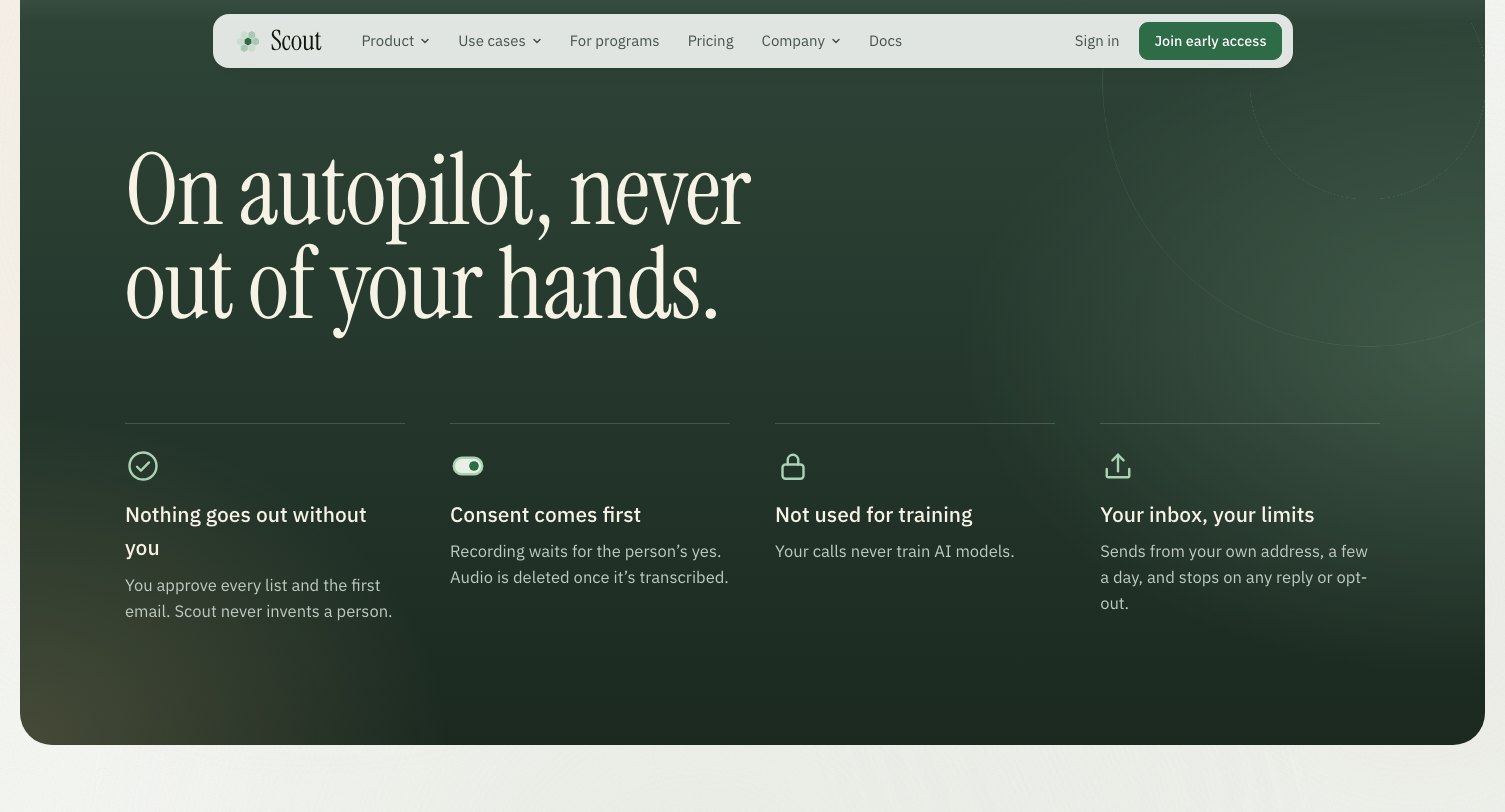
Anything the AI changes stays a suggestion until someone accepts it. No email goes out before the batch review.
No invented people
Every suggestion cites a real search result, and every chip or number Scout offers comes from the project's own data.
A guard on every draft
Dashes, exclamation marks and emojis are scrubbed. Drafts that claim research or a track record the sender never gave are refused.
Sends from your inbox
Gmail or Outlook, at 20 a day per person with a gap between sends, so replies land in the thread you already use.
A cheap model first
Workers AI handles most calls, Claude takes over when there's a key, and every paid call is metered and budgeted per day.
- React
- TypeScript
- Tailwind CSS
- Hono
- Cloudflare Workers
- D1
- Drizzle
- Queues
- R2
- Better Auth
- Workers AI
- Claude
- MCP
Applied AI
An agent you can leave running
A mission is a loop. Each tick it reconciles replies, bookings and bounces, finds more people if the pool runs low, drafts first emails, and opens one batch for review. Approved emails go out about one every five minutes, with follow-ups at four and seven days.
Replies are sorted by a cheap model. A clear yes gets the booking link, a no stops the follow-ups, an out-of-office waits, and anything else becomes a card with a drafted answer.
Every change to a prompt or model runs against the evals first. Adding checks on the cheap model's output took it from 73% to 94% of cases, and grounding the chat in the project's own data took it from 1 of 12 cases to 16 of 16.
4.77
judged score for chat on Haiku, out of 5
14×
cheaper than Sonnet for nearly the same score
Next
What I'd ship next
- 01Measure hours saved per team per week, the number the product was built to move.
- 02Standing searches that keep finding people for a project between missions.
- 03A public demo so visitors can try a mission without signing up.
- 04Open the evals' baseline on the docs, next to the rules they enforce.